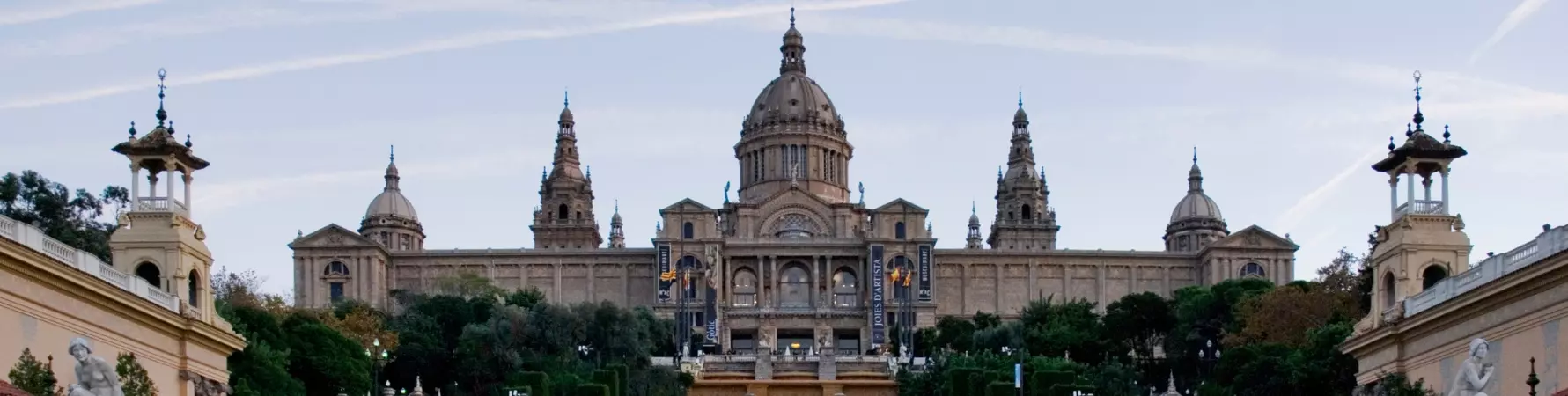




If you are looking for the best panoramic view of Barcelona combined with an unmatched dose of culture, the MNAC stop on the Barcelona City Tour is an essential destination. Located in the imposing National Palace on Montjuïc Mountain, the National Art Museum of Catalonia (MNAC) is an architectural landmark that overlooks the city and houses the most important collection of Catalan art in the world.
By hopping off our tourist bus at this stop, you will find yourself at the gateway to a historical journey spanning from the Romanesque period to the 20th-century avant-garde.
How to get to the MNAC?
Getting to the MNAC is incredibly simple and convenient thanks to the Barcelona City Tour. Our Orange Route has a stop dedicated exclusively to the museum (MNAC Stop), dropping you off right at the foot of the main grand staircase.
If you prefer to combine your trip with local public transport, you can take Metro Line 1 (Red) or Line 3 (Green) to the Plaça Espanya station. From there, you can walk up the avenues of the Fira de Barcelona or use the escalators that make the ascent to the palace much easier.
What is inside the National Museum of Barcelona?
The MNAC houses a collection that narrates the history of Catalan art through the centuries. The building itself, the National Palace, is a masterpiece built for the 1929 International Exhibition.
Inside, you will discover one of the most important art libraries in Europe, but its true treasure lies within its exhibition halls. The museum is world-renowned for its Romanesque Art section, considered the most significant of its kind globally, alongside rooms dedicated to Gothic, Renaissance, Baroque, and, of course, Catalan Modernism, where the genius of Gaudí and his contemporaries takes center stage.
What is the history of the National Art Museum?
The museum's history is closely linked to the cultural renaissance of Barcelona. The building was constructed as the main pavilion for the 1929 Exhibition, designed by Eugenio Cendoya and Enric Catà.
In 1934, it opened its doors as a museum, but it wasn’t until 1990—through the Catalonia Museums Act—that it was officially established as a National Museum. Over the decades, it has served not only as an exhibition center but as a symbol of Catalan identity, surviving turbulent historical periods and constantly renovating itself to offer a world-class museum experience.
Which paintings are in the MNAC?
The museum is famous for holding the most renowned Romanesque mural paintings in Spain, rescued from Pyrenean churches. Among its most iconic pieces are:
- The Apse of Sant Climent de Taüll: The crown jewel and one of the most powerful images of European Romanesque art.
- The Vicarage by Mariano Fortuny: One of the masterpieces of 19th-century painting.
- Works by Ramón Casas and Santiago Rusiñol: Essential for understanding Modernism and the bohemian life of Barcelona.
- Thyssen-Bornemisza Collection: The museum also hosts a deposit of works featuring masters such as Titian, Velázquez, and Rubens.
Frequently Asked Questions (FAQs)
How much is the entrance fee to the National Art Museum?
General admission is approximately €12 (valid for two days within one month). Visitors under 16 and over 65 usually enjoy free entry. We recommend checking updated prices and promotions when purchasing your Barcelona City Tour ticket.
When is the National Museum of Catalonia free?
You can visit the MNAC for free on Saturdays from 3:00 PM onwards and on the first Sunday of every month.
There are also open-house days on September 11th and 24th, and May 18th (International Museum Day).
Is the National Art Museum of Catalonia worth visiting?
Absolutely. Not only for the quality of its internal collections but for the complete experience: the building is majestic, and its rooftop viewpoints offer, without a doubt, some of the best 360º views of all Barcelona. It is a mandatory stop for any lover of art and photography.


